

An AI recruitment management system is a recruitment management system with AI built into the screening stage. It parses every resume, matches candidates to the job on meaning rather than keywords, scores them against the requirements you set, and ranks the shortlist with a reason beside each name. The AI narrows the list. Recruiters and hiring managers make the decision.
Key takeaways:
- Most products sold as AI recruiting software are an ATS with AI added on top. An AI recruitment management system runs the whole lifecycle with AI at the screening stage.
- The AI does four jobs: parse, match, score, rank. Each one has a check a human should be able to make.
- Time savings land in four places: screening volume, shortlisting, vendor submissions and reporting.
- The risks are bias, unexplained scores and legal exposure. The guardrail for all three is the same: a reason beside every score and a human who can override it.
- Evaluate with ten questions and a 30-day pilot on two live roles, not with a feature checklist.
Every recruiting tool now says it has AI. Greenhouse's 2026 buyer's guide puts it plainly: most platforms marketed as AI recruiting software are traditional applicant tracking systems with AI layered on (Greenhouse). That makes the buying question harder, not easier. This guide explains what an AI recruitment management system is, how the AI works at each step, where it saves time, where it fails, and how to test one before you sign. If you need the base definition first, read what a recruitment management system is.
What an AI recruitment management system is
Start with the recruitment management system. It runs hiring from the requisition to the hire: approvals, sourcing, screening, interviews, offers, vendor submissions and reporting. Add AI to the screening stage and the system changes what a recruiter sees when they open a role. Instead of a list sorted by date applied, they see a list sorted by fit, with the reason for each position. If the first round is the bottleneck, see what AI interview software and AI screening calls can take off the recruiter's desk.
RMS with AI built in vs ATS with AI bolted on
The difference is where the AI sits and what it can see. An AI add-on to an ATS sees applications. An AI recruitment management system sees the requisition, the hiring manager's must-haves, the agency submissions and the outcome of past hires. More context means better matches and better reasons.
How the screening step scores and ranks resumes is explained in our guide to AI resume screening.
| Traditional RMS | AI recruitment management system | ATS with AI add-on | |
|---|---|---|---|
| Screening | Keyword filters and manual review | Semantic matching, weighted scoring, ranked shortlist | Scoring on applications only |
| What the AI sees | Nothing | Requisition, must-haves, resumes, vendor submissions, past outcomes | Applications and the job post |
| Match reason | None | One or two lines beside every score | Varies; often a score alone |
| Override and log | Manual reorder | Recruiter drags the rank; the change is logged | Depends on vendor |
| Learns from your hires | No | Yes, from who was hired and who stayed | Rarely |
| Vendor submissions | Portal, no scoring | Portal, with the same AI score as direct applicants | Usually no portal |
How the AI works inside the recruitment workflow: parse, match, score, rank
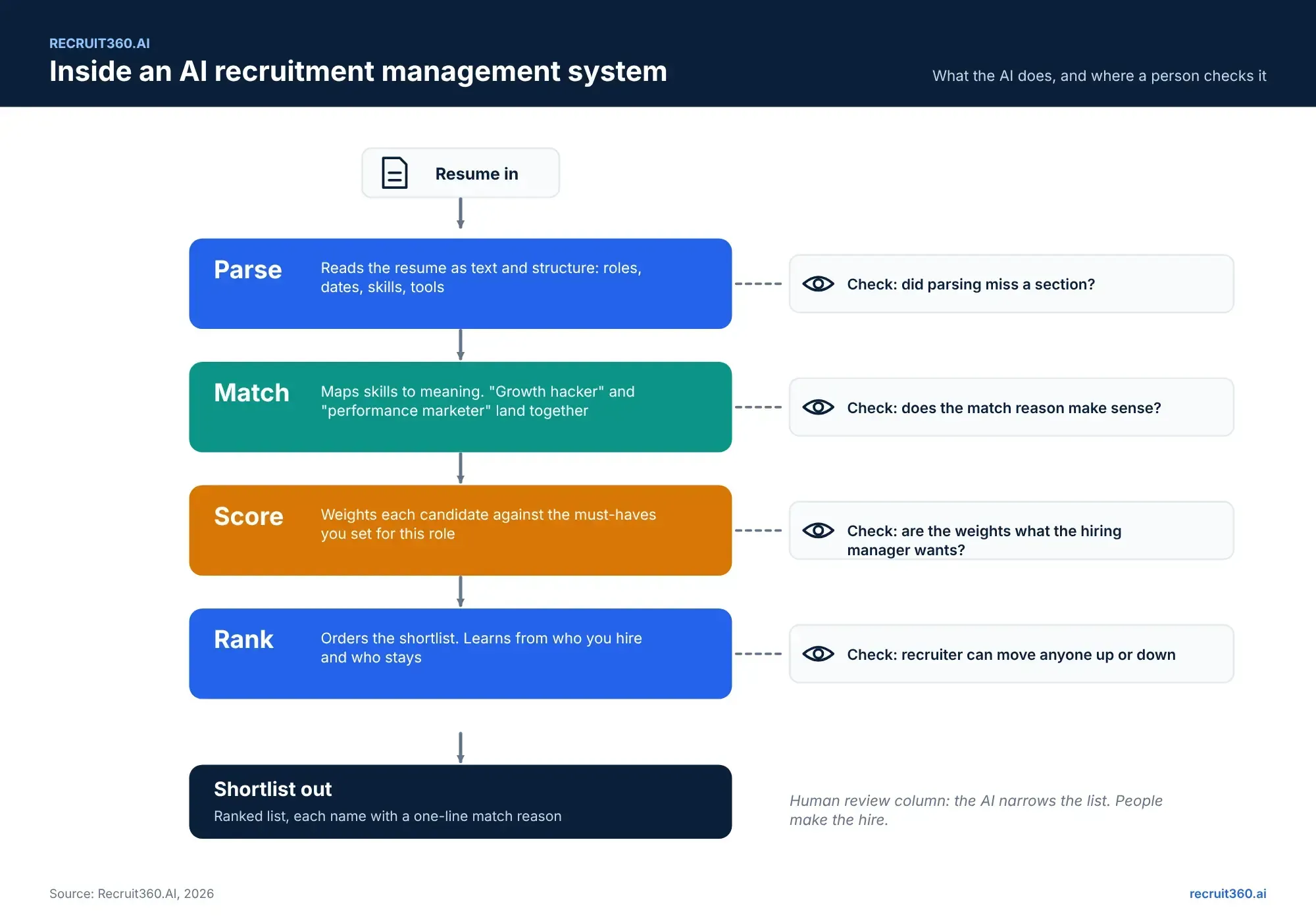
Four layers, in order. A resume goes in at the top. A ranked shortlist comes out at the bottom. Beside each layer is the check a person can make.
Cognitive resume parsing, the first step of the Profile Recommendation Engine
Parsing turns a resume into fields: roles, dates, employers, skills, tools, education. Older parsers worked on layout and broke on anything unusual. Cognitive parsing reads the document as text and works out what each part is, so a two-column design or a PDF export from a phone still parses. The check: open a parsed record and see if a section is missing.
Semantic candidate matching
Matching compares the parsed resume to the requisition on meaning. "Ran paid acquisition and scaled spend tenfold" matches a role asking for a performance marketer, even though neither phrase appears in the other. This is the step that separates AI recruitment software from a keyword filter. The check: read the match reason and ask whether a recruiter would agree.
Weighted scoring against your job requirements
Scoring applies the weights you set. A must-have skill counts more than a nice-to-have. A knockout, such as a work permit, removes the candidate from the ranked list but not from the record. The weights come from the hiring manager at requisition time, so the score reflects the role, not a generic template. The check: look at the weights and ask whether the hiring manager set them.
Predictive ranking that learns from your outcomes
Ranking orders the shortlist. In month one it uses the scores alone. Over time it learns from your data: who was hired, who passed probation, who left in six months. The model adjusts for your company, not for a benchmark. The check: a recruiter can move any candidate up or down, and the system logs who moved whom.
AI Interview and Agent Calling: the first round, run by agents
Once the shortlist exists, two agents take the first round. The AI Interview asks adaptive screening questions, scores the answers and records a transcript on the candidate record. Agent Calling is a voice agent that phones candidates to confirm interest, ask the knockout questions and book an interview slot. Neither declines anyone; a recruiter reviews every result. Tone and confidence scoring from video is the riskiest AI use in hiring, and Recruit360.AI keeps it out of the decision. Our guide to AI in recruitment covers the legal side of this.
Where AI recruitment software saves time: screening, shortlisting, vendor submissions and reporting
Screening volume: thousands of resumes in minutes
A role that draws 400 applications takes a recruiter two days to read. The AI reads all 400 before the recruiter opens the role. The recruiter reads the top 20 and the reasons.
Shortlisting: a ranked list before the recruiter opens the role
The shortlist is the first thing the recruiter sees, not the last thing they build. Hiring managers get it sooner, which is where time-to-fill moves.
Vendor submissions: duplicate detection and auto-tagging
Agency candidates come through the vendor portal, get the same AI score as direct applicants, and are checked for duplicates on the way in. No recruiter uploads an attachment or argues about ownership.
Reporting: time-to-fill and stage conversion without spreadsheets
Every stage is timestamped. The monthly report is a dashboard, and the HR leader reads it instead of waiting for it.
Where AI recruitment software fails: bias, black-box scores and legal exposure
The failures are known. So are the fixes. A vendor who cannot name both is the one to question.
Bias in training data
A model trained on past hires learns past patterns, including the ones you would not choose on purpose. If the company hired from three universities for ten years, the model may rank those three higher. The guardrail: ask where the training data comes from, ask for the last bias audit and its date, and keep the ranking advisory rather than automatic.
Black-box scores nobody can explain
A score of 87 with no reason cannot be defended to a candidate, a hiring manager or a regulator. The guardrail: every score carries one or two lines a recruiter can read, and every rank can be changed by a person. If the vendor cannot show the reason in the demo, there is no reason.
Legal exposure: FCRA, GDPR and the EU AI Act
The law is catching up. A proposed class action filed against Eightfold AI in January 2026 over alleged Fair Credit Reporting Act violations shows that how AI affects candidate outcomes now has legal consequences, not just product ones. Under GDPR, candidates in the EU can ask how an automated decision was made. The EU AI Act classes recruitment AI as high-risk, with documentation and oversight duties. The guardrail: no automatic rejection on an AI score, a written policy on how scores are used, and candidate disclosure.
The human-in-the-loop rule
One rule covers all three risks. The AI narrows the list. A person makes the call. Every override is logged. If a vendor's product cannot run that way, it is not ready for your hiring.
What an AI recruitment management system means for each role
Corporate recruiters
You start every role with a ranked list and a reason beside each name. The hours you save go into calls. Log why you override the AI; that feedback trains the model on your judgment.
Hiring managers
You set the must-haves at requisition time, and the scores reflect them. You see five strong profiles with reasons, not fifty resumes. Your feedback in the system sharpens the next shortlist.
HR and talent acquisition leaders
You get time-to-fill, stage conversion and agency performance from one dashboard. Set the policy on AI scores before a regulator sets it for you: advisory only, human decision, disclosure to candidates.
IT and HRIS admins
You own the data path. Ask for SOC 2 and GDPR evidence, role-based access, an API to the HRIS, a data retention schedule and a model audit log. One system with those is easier to defend than three without.
How to evaluate an AI recruitment management system
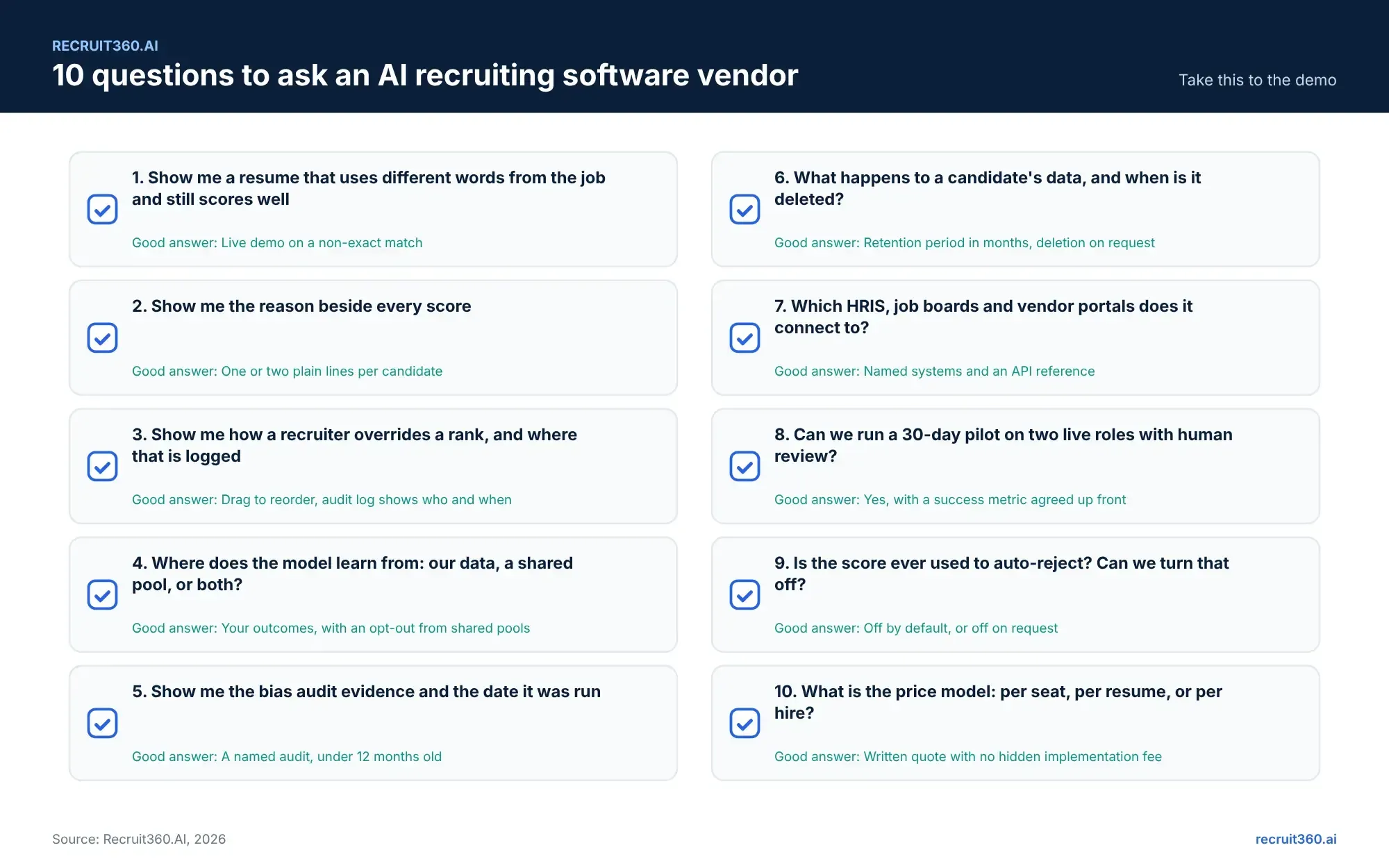
A feature list will not tell you whether the AI works. A demo on your own role will. Take these ten questions to the call and insist on seeing, not hearing, the answers.
10 questions to ask on the demo
Frequently asked questions
What is an AI recruitment management system?
It is a recruitment management system with AI at the screening stage. It parses resumes, matches on meaning, scores against your requirements and ranks the shortlist with a reason beside each name, inside the same system that runs requisitions, vendors and reporting.
Is AI recruiting software biased?
It can be, because it learns from past hiring data. The controls are a bias audit, explainable scores, human override and no automatic rejection on a score. Ask a vendor for all four.
Can AI replace recruiters?
No. AI reads and ranks. Recruiters interview, judge and close. Teams that use AI well hire faster with the same recruiters, not with fewer.
What is the difference between AI recruiting software and an ATS?
An ATS tracks applications. AI recruiting software is a broad label that covers sourcing tools, screening add-ons and full platforms. An AI recruitment management system is the full platform: lifecycle plus AI screening. See RMS vs ATS for the base comparison.
How much does AI recruitment software cost?
Pricing is per seat, per resume processed or per hire, with a platform fee for enterprises. Costs vary widely. Ask for the implementation fee and integration costs as separate lines.
Does an AI RMS work for staffing agencies?
Yes. Agencies use it to run many clients and requisitions from one dashboard, with the AI scoring candidates against each client's role. Corporate teams invite their agencies through the vendor portal.