

The best AI recruiting software depends on where your hiring friction is. For inbound application volume, an applicant tracking system with AI screening built in, such as Greenhouse or Workable. For finding people who have not applied, an AI sourcing tool such as SeekOut or hireEZ. For teams that run requisition approvals, staffing agencies and many hiring managers, an AI recruitment management system that covers the whole lifecycle. Pick the type first, then the tool.
Key takeaways:
- Most tools sold as AI recruiting software are an ATS with AI layered on. That is fine if an ATS is what you need.
- Four types exist: AI ATS, AI recruitment management system, AI sourcing tool, and AI interview or assessment tool. Compare within a type, not across.
- Five checks decide the purchase: explainability, bias and compliance evidence, workflow coverage, integration, and cost including implementation.
- Pricing is rarely public. Ask for total cost at your seat count, with implementation and integrations as separate lines.
Disclosure first: this post is published by Recruit360.AI, which appears in the list below. It is listed once, in its own row, with the same format as every other tool, including the caveat. Greenhouse's 2026 buyer's guide makes the point that most platforms marketed as AI recruiting software are traditional applicant tracking systems with AI layered on (Greenhouse). We agree, and we think the useful comparison is by type rather than by brand, because an AI sourcing tool and an AI ATS are not competing for the same job. This post sorts ten tools into four types, gives each a best-for, an AI capability and a watch-for, and ends with the five checks and a scorecard.
AI recruiting software compared at a glance
| Tool | Type | Best for | Standout AI capability | Watch for |
|---|---|---|---|---|
| Greenhouse | AI ATS | Mid-market and enterprise teams with structured hiring | AI in interview plans, scorecard summaries, job drafts and matching | Implementation investment; slow for teams needing results in days |
| Workday Recruiting | AI ATS inside an HCM suite | Enterprises already on Workday | Candidate matching and job recommendations in the HCM layer | 12-month-plus implementation; career site sold separately |
| iCIMS | AI ATS, enterprise | Complex approvals, compliance, multi-team hiring | Generative assistant for interview guides, job descriptions, candidate search | Configuration usually needs the vendor; hiring manager experience |
| Workable | AI ATS, SMB | Small and mid-sized teams wanting fast setup | AI recommendations from its sourcing database; application screening and ranking | Reporting and governance limits as teams grow |
| Ashby | AI ATS, analytics-first | Startup and growth teams with recruiting ops | AI notetaker; AI interviewer in private beta | Advanced analytics is a paid add-on |
| SeekOut | AI sourcing | Sourcing-led teams, technical and diversity search | AI candidate filters, outreach sequencing, follow-up automation | ATS sync gaps; outreach does not always reach the system of record |
| hireEZ | AI sourcing and outreach | Mid-market and enterprise outbound teams | Contact discovery across sources; automated sequences | Documented LinkedIn account restriction risk |
| HireVue | AI interview and assessment | Enterprise programmes at volume | AI-scored video assessments | ATS write-back gaps; multi-stage data does not reliably sync |
| Paradox | Conversational AI | High-volume hourly hiring | Chat-based screening and scheduling | Narrow outside high-volume use cases |
| Recruit360.AI | AI recruitment management system | Teams with requisition approvals, agencies and many hiring managers | Semantic matching, weighted scoring, ranked shortlist with reasons; vendor portal | Younger product; smaller integration catalogue than the suites |
How we evaluated AI recruiting tools: five criteria, weighted
Five criteria and how each was weighted
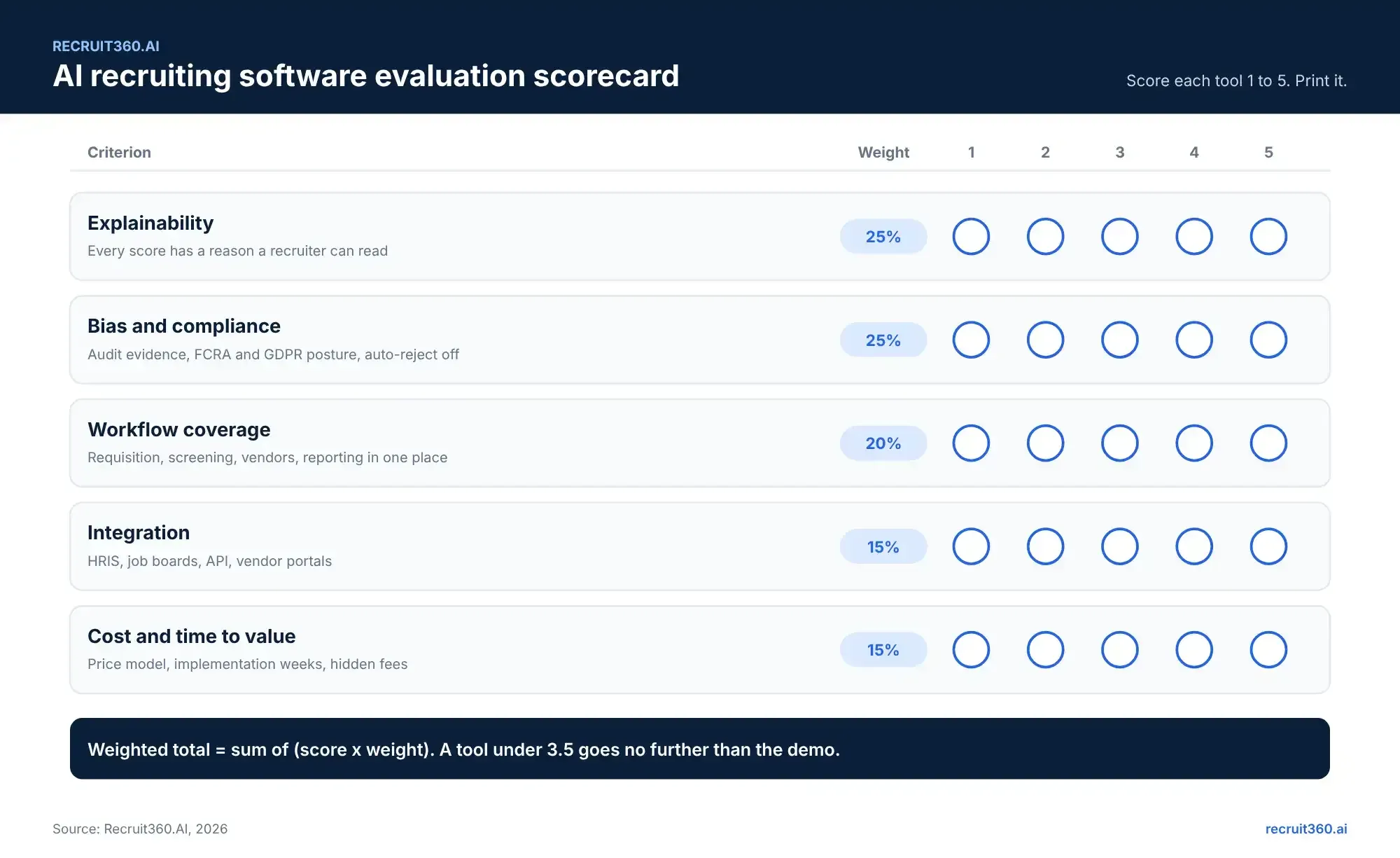
Explainability (25%): does every score come with a reason a recruiter can read? Bias and compliance (25%): is there a dated audit, and can auto-reject be turned off? Workflow coverage (20%): how much of requisition-to-hire does the tool run? Integration (15%): HRIS, job boards, API, vendor portals. Cost and time to value (15%): price model, implementation weeks, hidden fees.
What we did not score
We did not run a user survey or a benchmark test. Capabilities and caveats come from each vendor's published material and from the Greenhouse 2026 guide, linked in Sources. Where a vendor publishes no pricing, we say so rather than estimate. Read the rows as a map of the category, then run the scorecard at the end on the two or three tools that fit your type.
This is a global list. It does not repeat the tools in our India guides. For Indian staffing agencies, read best recruitment software for staffing agencies in India, which covers Zoho Recruit, Ceipal, Keka Hire, Naukri RMS and others with prices in rupees. For a switch from a tool you already run, read the Zoho Recruit alternatives and Ceipal alternatives guides.
The 10 best AI recruiting software tools, by type: ATS, HCM suite, sourcing, interviewing, RMS
Grouped by type. Within each type, the tools compete. Across types, they do not.
1. Greenhouse: structured hiring with AI inside the ATS
Best for: mid-market and enterprise teams that want a structured, repeatable process. AI capability: AI in interview plans, scorecard summaries, job post drafts and talent matching, plus governed connectivity to outside models. Watch for: it rewards teams who invest in setup; those who need results in days will find it slow. Pricing: not published.
2. Workday Recruiting: AI inside the HCM suite
Best for: enterprises already running Workday for HR. AI capability: candidate matching and job recommendations inside the HCM layer. Watch for: implementations commonly run past twelve months, the career site is sold separately, and the Greenhouse guide notes a weak reputation among TA professionals and job seekers. Pricing: not published.
3. iCIMS: enterprise talent cloud
Best for: enterprises with complex approvals, compliance needs and many hiring teams. AI capability: a generative assistant for interview guides, job descriptions and candidate search. Watch for: configuration usually needs the vendor, and hiring managers can find the experience heavy. Pricing: not published.
4. Workable: all-in-one for SMBs
Best for: small and mid-sized teams that want to be live in days. AI capability: candidate recommendations from its own sourcing database, plus application screening and ranking. Watch for: reporting and governance limits appear as the team grows. Pricing: described as transparent; no figure published in the source.
5. Ashby: analytics-first ATS
Best for: startup and growth teams with a recruiting operations function. AI capability: an AI notetaker for interview transcription and summaries; an AI interviewer in private beta. Watch for: advanced analytics is a paid add-on, and the full value needs someone to own the dashboards. Pricing: scales with seat count; no figure published.
6. SeekOut: AI sourcing for technical and diversity search
Best for: sourcing-led teams hunting people who have not applied. AI capability: AI candidate filters, outreach sequencing and follow-up automation. Watch for: ATS sync gaps; outreach activity does not always reach the system of record. Pricing: not published.
7. hireEZ: outbound sourcing and outreach at scale
Best for: mid-market and enterprise teams whose hiring is mostly outbound. AI capability: contact discovery across data sources and automated outreach sequences. Watch for: a documented risk of LinkedIn account restrictions. Pricing: not published.
8. HireVue: AI video interviews and assessments
Best for: enterprise programmes screening at volume, such as campus or retail. AI capability: AI-scored video assessments that flag skill-demonstrating moments. Watch for: ATS write-back gaps; multi-stage evaluation data does not reliably sync. Video scoring is also the AI use regulators look at hardest; see AI in recruitment. Pricing: not published.
9. Paradox: conversational AI for high-volume hiring
Best for: hourly and high-volume hiring where speed to interview matters most. AI capability: chat-based screening, scheduling and candidate questions. Watch for: narrow outside that use case; it is a front end to an ATS, not a replacement. Pricing: not published.
10. Recruit360.AI: AI recruitment management system with a vendor portal
Disclosure: this is our product. Best for: teams that run requisition approvals, work with staffing agencies and have many hiring managers in the process. AI capability: cognitive resume parsing, semantic matching, weighted scoring against the hiring manager's must-haves, and a ranked shortlist with a reason beside each name; agency submissions through the vendor portal get the same score. Watch for: a younger product with a smaller integration catalogue than the suites; check your HRIS connector on the demo. Pricing: 15-day free trial with no credit card; quotes on request. The AI recruitment management system guide explains the four AI layers.
AI ATS vs AI recruitment management system vs sourcing tool: which type do you need?
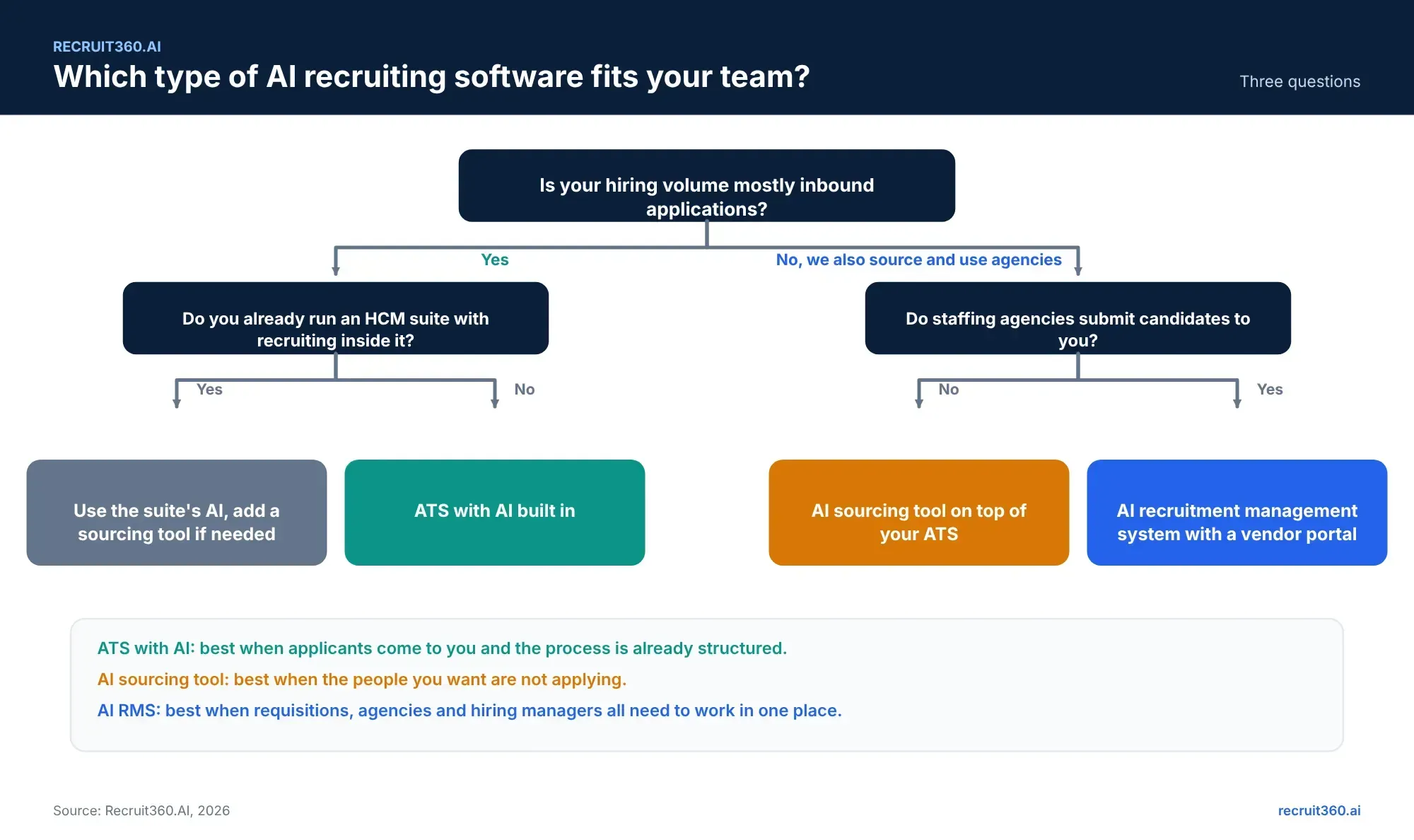
Three questions sort most teams. Answer them before you book a single demo.
Pick an ATS with AI if
Applicants come to you. One recruiter owns each role from posting to offer. Approvals are informal. You do not use agencies. The AI you need is screening and ranking on inbound volume, and Greenhouse, Workable, Ashby or iCIMS will do it. For the base comparison, read RMS vs ATS.
Pick an AI RMS if
Requisitions need sign-off before a job goes live. Staffing agencies send you candidates. Hiring managers need to score and comment inside the system. Leadership asks for time-to-fill by department. You want agency and direct candidates in one pipeline with one score. That is the job of an AI recruitment management system.
Pick a sourcing tool if
The people you want are not applying. Your hiring is outbound and the bottleneck is finding and reaching candidates, not processing them. SeekOut or hireEZ sits on top of whichever system of record you run.
What to check before you buy AI recruiting software: explainability, bias audits, integrations, implementation cost
Five checks, and they apply to every type. Score each tool one to five and weight them as in the scorecard.
Explainability and override
Every score shows a reason a recruiter can read. Every rank can be changed by a person, and the change is logged. If the demo cannot show this, stop. Our AI resume screening guide shows what a good reason looks like.
Bias audits and compliance evidence
Ask for the last bias audit and its date. Ask whether the tool can auto-reject on a score and whether that can be switched off. Ask how it handles GDPR explanation requests and NYC Local Law 144 audits. A vendor who has these answers ready has been asked before.
Integration with your HRIS and vendor portals
Name your HRIS, your job boards and your calendar, and ask for the connector or the API reference for each. If agencies send you candidates, ask whether they get a portal or an email address. The watch-for column above is mostly integration gaps, because that is where most tools fall short.
Implementation time and hidden costs
The Greenhouse guide's FAQ puts it plainly: some vendors include AI in the core product, others sell it as an add-on with usage limits or seat minimums, and implementation and integration fees often do not appear in the first pricing conversation (Greenhouse). Ask for total cost at your seat count, with implementation and each integration as a separate line, before you compare any two quotes.
Frequently asked questions
What is the best AI recruiting software for enterprises?
For enterprises already on an HCM suite, the suite's recruiting module plus a sourcing tool. For enterprises with complex approvals and agencies outside a suite, an AI recruitment management system or an enterprise ATS such as iCIMS. Compare on explainability, compliance evidence and integration before features.
What is the best AI recruiting software for staffing agencies?
Agencies need candidate relationship features plus submission tracking per client. An agency-focused ATS or an RMS that tracks requisitions per client fits. When a client runs an RMS with a vendor portal, the agency submits through it and keeps its own system for its candidates.
How much does AI recruiting software cost?
Most vendors do not publish prices. Models are per seat, per resume or per hire, with platform tiers for enterprises. AI is sometimes an add-on with usage limits. Implementation and integration fees are usually quoted after the first call, so ask for total cost at your seat count up front.
For Indian prices in rupees, per seat and per requisition, read recruitment software pricing in India.
Is an AI ATS different from an ATS with AI features?
In practice, no. Both are applicant tracking systems with AI added to screening, matching or scheduling. The real difference is scope: an ATS, with or without AI, covers application to offer. An AI recruitment management system covers requisition to hire.
What types of AI recruiting tools are there?
Four main types: AI applicant tracking systems, AI recruitment management systems (like Recruit360.AI), AI sourcing tools and AI interview tools. Most teams need the RMS or ATS as their core and add the others.
How do I evaluate AI recruiting tools for bias?
Ask for a dated bias audit, a reason beside every score, a human override that is logged, and the option to turn off automatic rejection. Run a 30-day pilot with a recruiter reviewing every output and compare the override rate.